




In this blog, Niche Thyself will help you clearly understand what an Observable is, why it is used, and where it plays an important role in Angular applications.
Observables are mainly used to perform asynchronous operations and handle data streams efficiently. They are a core part of Angular’s reactive programming model and are widely used in Single Page Applications (SPAs).
Let’s break this down in simple terms.
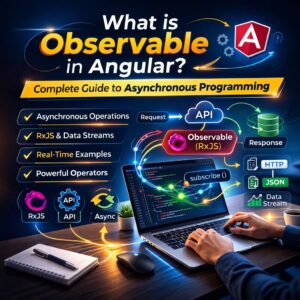
Understanding Asynchronous Operations
JavaScript is a single-threaded language, which means it executes code sequentially, line by line.
In synchronous execution:
-
One task must complete before the next task starts.
-
If an HTTP request is sent to the backend, the program waits for the response.
-
The rest of the code is blocked until the response is received.
This type of execution is called blocking or synchronous code.
To solve this problem, we use asynchronous operations.
What is Asynchronous Code?
Asynchronous code:
-
Runs in the background
-
Does not block the main execution thread
-
Allows other code to execute while waiting for a response
For example, when making an HTTP request, the application continues running instead of waiting for the server response.
In Angular, asynchronous operations are handled using:
-
Promises
-
Observables (RxJS)
Among these, Observables are more powerful and flexible.
What is Observable?
An Observable represents a stream of data that can be observed over time.
It is part of the RxJS (Reactive Extensions for JavaScript) library and is heavily used in Angular applications.
In simple terms:
An Observable is an interface that returns multiple values over time, either synchronously or asynchronously.
Observables:
-
Emit data
-
Allow us to react to data changes
-
Handle asynchronous events efficiently
They are commonly used for:
-
HTTP requests
-
User input events
-
Real-time data updates
-
WebSocket communication
Observable in Angular
In Angular, Observables are used to manage data streams and asynchronous operations.
For example:
-
A user requests product data from the UI (.html file).
-
The request goes to the component (.ts file).
-
The component calls a service.
-
The service sends an HTTP request to the backend server.
-
The backend processes the request and sends a response.
-
The Observable captures the response.
-
Angular subscribes to the Observable and processes the data.
The key concept here is subscription.
Observables do not execute automatically. They only start working when we call the subscribe() method.
Real-Life Use Cases of Observable in Angular
Let’s consider two cases when making an HTTP request:
Case 1: Backend Server Not Available
If the server is unavailable:
-
The Observable monitors the request.
-
It may retry (if configured using operators like
retry). -
If the server still does not respond, it notifies Angular.
-
The connection is terminated safely.
This prevents application crashes and improves error handling.
Case 2: Backend Server Available
If the server responds:
-
The Observable captures the response.
-
Angular’s
subscribe()method processes the data. -
The UI updates dynamically.
This makes Angular applications smooth and responsive.
Key Features of Observables
Here are some important characteristics:
1. Emit Multiple Values
Observables can emit multiple values over time.
2. Lazy Execution
They are lazy. They do not execute until we subscribe using subscribe().
3. Can Be Cancelled
Subscriptions can be cancelled using unsubscribe(), which helps prevent memory leaks.
4. Powerful Operators
Observables support operators like:
-
map
-
filter
-
retry
-
mergeMap
-
switchMap
These operators allow data transformation and complex asynchronous workflows.
5. Real-Time Data Handling
Observables are ideal for:
-
Chat applications
-
Live dashboards
-
Streaming data
-
Notifications
Why Observables Are Important in Single Page Applications (SPAs)
In SPAs:
-
Data updates frequently
-
UI must respond instantly
-
Background operations must not block rendering
Observables ensure:
-
Smooth user experience
-
Non-blocking execution
-
Efficient data flow management
That is why Observables are a foundation of Angular development.
Conclusion
At Niche Thyself, we emphasize mastering core Angular concepts like Observables because they are essential for building modern, scalable, and responsive applications.
Observables:
-
Handle asynchronous operations efficiently
-
Support reactive programming
-
Allow multiple data emissions
-
Improve performance and user experience
Understanding Observables and RxJS operators will significantly improve your Angular development skills and help you build robust applications.
If you want to master Angular, API handling, and reactive programming, explore our industry-focused training programs at Niche Thyself and take your development skills to the next level.