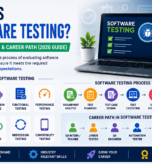




Software plays an important role in almost every industry, from banking and healthcare to e-commerce and education. But before software reaches users, it needs to be checked for quality, reliability, security, and performance. This is where software testing comes in.
If you’re wondering What Is Software Testing?, it is the process of evaluating software to identify defects and verify that an application works according to its requirements. For beginners planning a career in QA, understanding What Is Software Testing? is the first step toward learning manual and automation testing.
In this complete 2026 guide, we’ll explain software testing types, the testing process, important tools, required skills, and career opportunities.
What Is Software Testing?
Software testing is the systematic process of checking an application to find bugs, verify functionality, and ensure that the product meets business and user requirements.
Testers evaluate software from different perspectives, including:
- Functionality
- Usability
- Performance
- Security
- Compatibility
- Reliability
Understanding What Is Software Testing? also means understanding that testing isn’t simply about finding bugs. A QA professional helps improve the overall quality and user experience of a product.
Why Is Software Testing Important?
Modern applications can have thousands of features and millions of possible user interactions. Even a small defect can cause financial loss, security problems, or poor customer experiences.
Software testing helps organizations:
- Detect defects before release
- Improve product quality
- Reduce development costs
- Protect user data
- Improve customer satisfaction
- Reduce production failures
This is why software testing continues to be an important part of the software development lifecycle in 2026.
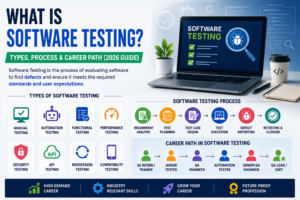
Types of Software Testing
Understanding the different types is an important part of learning What Is Software Testing?
1. Manual Testing
Manual testing is performed by testers without using automation scripts.
Common activities include:
- Writing test cases
- Executing test scenarios
- Reporting bugs
- Retesting fixes
- Exploratory testing
Manual testing is often the starting point for beginners entering a QA career.
2. Automation Testing
Automation testing uses scripts and tools to execute repetitive test cases automatically.
Popular tools include:
- Selenium
- Playwright
- Cypress
- Appium
Automation can make regression testing faster and more efficient.
3. Functional Testing
Functional testing verifies whether individual features work according to requirements.
For example, an e-commerce tester may verify:
- Login
- Product search
- Add to cart
- Checkout
- Payment
4. Performance Testing
Performance testing checks how an application behaves under different levels of traffic and workload.
It includes:
- Load testing
- Stress testing
- Scalability testing
- Endurance testing
5. Security Testing
Security testing identifies vulnerabilities that could allow unauthorized access or data loss.
Testers may evaluate authentication, authorization, input validation, and other security-related areas.
6. API Testing
API testing verifies communication between different software components.
Tools such as Postman and automation frameworks can be used to test:
- GET
- POST
- PUT
- PATCH
- DELETE
7. Regression Testing
Regression testing checks whether new changes have negatively affected existing functionality.
Automation is particularly useful for large regression suites.
Software Testing Process
Now that you understand What Is Software Testing?, let’s look at the typical testing process.
Step 1: Requirement Analysis
QA professionals study project requirements and identify what needs to be tested.
Step 2: Test Planning
The team defines:
- Testing scope
- Resources
- Timeline
- Tools
- Testing approach
Step 3: Test Case Design
Testers create test scenarios and detailed test cases based on requirements.
Step 4: Test Environment Setup
The required hardware, software, databases, browsers, devices, and test data are prepared.
Step 5: Test Execution
Testers execute test cases and compare actual results with expected results.
Step 6: Defect Reporting
When a problem is discovered, testers report it using tools such as Jira.
A good bug report normally includes:
- Title
- Steps to reproduce
- Expected result
- Actual result
- Severity
- Screenshots or evidence
Step 7: Retesting and Regression Testing
After developers fix a defect, testers verify the fix and check whether other features were affected.
Step 8: Test Closure
At the end of testing, teams prepare reports and document lessons learned.
Software Testing Tools You Should Know in 2026
If you’re planning a QA career, learning the right tools is important.
Popular tools include:
- Selenium
- Playwright
- Cypress
- Postman
- Jira
- Git
- GitHub
- Jenkins
- TestNG
AI tools are also becoming increasingly useful in QA workflows.
How AI Is Changing Software Testing
AI is transforming the way testers create and execute tests.
Tools such as ChatGPT and Gemini can help testers:
- Generate test cases
- Explain testing concepts
- Create test data
- Generate automation code
- Analyze error messages
- Improve documentation
- Assist with debugging
However, AI should support a tester’s judgment rather than completely replace human validation.
For anyone researching What Is Software Testing? as a career option, learning AI-assisted testing can provide an additional advantage in 2026.
Skills Required to Become a Software Tester
A successful QA professional needs more than tool knowledge.
Important skills include:
Technical Skills
- Software testing fundamentals
- Test case design
- Bug reporting
- API testing
- SQL basics
- Automation testing
- Git and CI/CD fundamentals
Soft Skills
- Communication
- Analytical thinking
- Attention to detail
- Problem-solving
- Team collaboration
Software Testing Career Path
One reason many beginners search What Is Software Testing? is because they are considering a career in QA.
A typical career path can look like:
QA Intern / Trainee → Junior QA Tester → QA Engineer → Automation Tester → Senior QA Engineer → SDET / QA Lead
With experience, professionals can move into leadership, automation architecture, performance testing, security testing, or specialized QA roles.
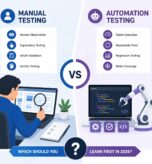
Manual Testing vs Automation Testing
A common question after learning What Is Software Testing? is whether beginners should choose manual or automation testing.
Manual testing is easier to start with because it helps you understand core testing concepts.
Automation testing requires additional programming and framework knowledge but can provide broader career opportunities.
For beginners, a practical approach is:
Manual Testing → Programming Basics → API Testing → Automation Testing → Framework Development → CI/CD
How to Start a Software Testing Career in 2026
If you’re completely new to QA, follow this roadmap:
Month 1
Learn software testing fundamentals, SDLC, STLC, test cases, and bug life cycle.
Month 2
Practice manual testing and learn Jira, Agile, and basic SQL.
Month 3
Learn Java, Python, or JavaScript fundamentals.
Month 4
Start Selenium or Playwright automation.
Month 5
Learn API testing, Git, and real-world testing workflows.
Month 6
Build projects, create a QA portfolio, update your resume, and prepare for interviews.
This practical roadmap can help beginners turn their knowledge of What Is Software Testing? into real-world QA skills.
How Niche Thyself Can Help You Build QA Skills
At Niche Thyself, the focus is on helping aspiring QA professionals understand both fundamental and modern testing practices.
A career-focused learning approach can include:
- Manual Testing
- Automation Testing
- Selenium
- Playwright
- API Testing
- AI-Assisted Testing
- Real-Time Projects
- Interview Preparation
- Career Guidance
Combining testing fundamentals with automation and AI skills can help learners prepare for the changing QA industry.
Frequently Asked Questions
Is software testing a good career in 2026?
Yes. QA remains an important part of software development, while automation and AI are creating new opportunities for skilled testers.
Is coding required for software testing?
Manual testing can be started without advanced coding knowledge. However, programming becomes important when moving into automation testing.
Can freshers become software testers?
Yes. Freshers can start with manual testing fundamentals, build practical projects, learn automation tools, and prepare for entry-level QA positions.
Which automation tool should beginners learn?
Selenium remains widely used, while Playwright is an increasingly popular option for modern web automation. The best choice depends on your target job market and technology stack.
Can AI replace software testers?
AI can automate certain repetitive tasks, but human testers remain important for exploratory testing, business understanding, risk analysis, usability evaluation, and quality decisions.
Final Thoughts
So, What Is Software Testing? It is much more than simply finding bugs. It is a structured process that helps ensure software is functional, reliable, secure, and ready for real users.
In 2026, QA professionals should understand manual testing while also developing automation, API, programming, CI/CD, and AI-assisted testing skills.
If you’re planning to enter the software testing industry, start with the fundamentals, practice with real applications, build projects, and gradually move toward automation. With the right learning path, software testing can become a strong foundation for a long-term QA career.