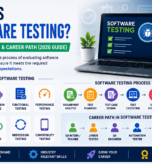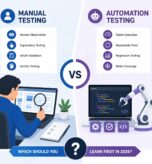




If you are planning a career in software testing, one of the biggest questions you will face is Manual Testing vs Automation Testing: Salary, Demand & Career Comparison. Both paths offer opportunities, but the skills, career growth, salary potential, and day-to-day responsibilities can be very different.
Manual testing remains an important foundation for QA professionals, while automation testing has become increasingly important as development teams adopt CI/CD, faster release cycles, cloud platforms, and AI-assisted testing.
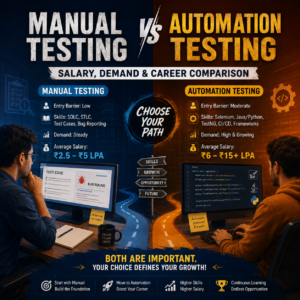
So, which path should you choose?
The practical answer is not simply manual testing or automation testing. The strongest QA professionals understand testing fundamentals first and then build automation, API, programming, and modern AI skills.
This ultimate guide explains Manual Testing vs Automation Testing: Salary, Demand & Career Comparison, including responsibilities, skills, salary factors, job demand, career growth, learning difficulty, tools, and a practical roadmap for beginners and experienced testers.
Manual Testing vs Automation Testing: Quick Comparison
Before going deeper into Manual Testing vs Automation Testing: Salary, Demand & Career Comparison, here is a quick overview.
| Factor | Manual Testing | Automation Testing |
|---|---|---|
| Coding Requirement | Low or none | Moderate to high |
| Beginner Friendly | Very high | Moderate |
| Test Execution | Human-driven | Script-driven |
| Repetitive Testing | Time-consuming | Highly efficient |
| Exploratory Testing | Excellent | Limited |
| Regression Testing | Possible but slower | Highly suitable |
| Initial Learning Curve | Easier | Higher |
| Career Growth | Good | Very strong |
| Salary Potential | Good | Generally higher |
| CI/CD Integration | Limited | Strong |
| AI Integration | Increasing | High |
| Best For | Testing fundamentals | Technical QA careers |
The comparison shows why modern QA professionals increasingly combine both approaches.
What Is Manual Testing?
Manual testing is the process of testing software without relying on automated test scripts to execute the test steps.
A manual tester interacts with an application like a real user and checks whether the software behaves according to its requirements.
Typical responsibilities include:
- Understanding requirements
- Creating test scenarios
- Writing test cases
- Executing test cases
- Reporting defects
- Retesting fixes
- Performing regression testing
- Exploratory testing
- Supporting user acceptance testing
Manual testing is especially valuable when human observation and product understanding are important.
For example, an automation script can verify whether a button works, but a human tester may notice that the button is confusing, poorly positioned, or difficult to use.
What Is Automation Testing?
Automation testing uses software tools and scripts to execute predefined tests.
Instead of repeatedly performing the same steps manually, a tester creates an automated test that can execute those steps repeatedly.
Common automation technologies include:
- Selenium
- Playwright
- Cypress
- Appium
- TestNG
- JUnit
- REST Assured
- Postman
Selenium’s official documentation also emphasizes that browser automation should be used thoughtfully and that manual testing can sometimes be more effective when the application is changing rapidly or when automation does not provide enough short-term value.
Manual Testing vs Automation Testing: Salary Comparison
Salary is one of the most common reasons people research Manual Testing vs Automation Testing: Salary, Demand & Career Comparison.
There is no single salary for either career. Compensation depends on:
- Experience
- Location
- Company type
- Technical skills
- Domain knowledge
- Programming ability
- Automation framework expertise
- API testing knowledge
- CI/CD experience
- Communication skills
In general, automation-focused QA roles tend to have a higher salary ceiling because they require programming and engineering skills.
Indicative India ranges often look like this:
| Experience | Manual QA | Automation QA / SDET |
| Fresher | ₹2.5–5 LPA | ₹4–8 LPA |
| 2–4 Years | ₹5–9 LPA | ₹8–16 LPA |
| 5–8 Years | ₹8–15 LPA | ₹14–30 LPA |
| Senior | ₹12–22+ LPA | ₹20–40+ LPA |
These are broad market-oriented ranges rather than guaranteed salaries. Actual offers can vary substantially between service companies, startups, product companies, GCCs, cities, and individual candidates.
The important lesson from Manual Testing vs Automation Testing: Salary, Demand & Career Comparison is that experience alone does not determine salary. Technical depth can have a major impact on earning potential.
Why Automation Testing Usually Has a Higher Salary Ceiling
Automation testers need to combine testing knowledge with programming and engineering skills.
A strong automation professional may need to understand:
- Java, Python, JavaScript, or TypeScript
- Selenium or Playwright
- API testing
- Git
- CI/CD
- Test frameworks
- Design patterns
- SQL
- Reporting
- Debugging
- Test architecture
As professionals move toward SDET and Quality Engineering roles, their responsibilities can become closer to software engineering.
This is one reason automation often offers stronger long-term salary growth.
For a deeper salary-focused guide, connect this pillar page to your article:
Internal Link: Software Tester Salary in India 2026
Manual Testing vs Automation Testing: Demand Comparison
The demand question is more complicated than simply asking whether manual testing is dead.
Manual testing is still required for:
- Exploratory testing
- Usability testing
- Accessibility testing
- New feature validation
- Business workflow validation
- User experience testing
- Requirements analysis
- Domain-specific testing
However, repetitive regression testing is a strong candidate for automation.
Government QA job descriptions also commonly combine manual and automated testing responsibilities, including functional, regression, integration, performance, API, and automation testing.
The modern market therefore favors testers who can understand both manual testing and automation.
Is Manual Testing Still a Good Career?
Yes, but the strategy matters.
Manual testing is an excellent starting point for learning:
- How applications work
- How requirements become test cases
- How bugs are identified
- How users interact with software
- How to think about edge cases
- How QA teams collaborate with developers
The problem is relying exclusively on manual execution for years without developing additional technical skills.
A better approach is:
Manual Testing → API Testing → Programming → Automation → CI/CD → Advanced QA
This approach allows you to use manual testing as a foundation rather than treating it as the final destination.
Is Automation Testing Difficult for Beginners?
Automation testing has a steeper learning curve because coding is involved.
However, you do not need to become an expert software developer before starting.
Begin with:
- Programming fundamentals
- Variables and data types
- Conditions
- Loops
- Functions
- Arrays and collections
- Object-oriented programming
- Basic debugging
Then move to an automation framework.
If you are completely new to QA, your earlier beginner roadmap can support this pillar:
Internal Link: Zero to QA Engineer in 90 Days – Complete Roadmap for Beginners
Selenium vs Playwright for Automation Testing
Selenium remains a widely used browser automation technology, while Playwright has become an important modern option for web application automation.
Selenium WebDriver provides browser automation through a standardized interface and supports multiple browsers and programming languages.
Playwright is popular for modern web testing because it provides features designed around contemporary browser automation workflows.
For a beginner, the best choice depends on your target jobs.
If your goal is broad enterprise exposure, Selenium is still valuable.
If you want to work with modern web applications and newer automation stacks, Playwright is worth learning.
You can eventually learn both.
Internal Link: Selenium Architecture Explained Simply
Manual Testing vs Automation Testing: Skills You Need
A successful QA career requires more than knowing one testing tool.
Manual Testing Skills
Learn:
- SDLC
- STLC
- Test case design
- Defect management
- Regression testing
- Smoke testing
- Sanity testing
- Exploratory testing
- Agile and Scrum
- Jira
Automation Testing Skills
Add:
- Programming
- Selenium or Playwright
- Test frameworks
- Page Object Model
- API testing
- Git
- CI/CD
- Test reporting
- Debugging
Modern QA Skills
You should also consider:
- SQL
- Cloud fundamentals
- Performance testing
- Security awareness
- AI-assisted testing
- Continuous testing
The Role of AI in Software Testing
AI is becoming another important part of Manual Testing vs Automation Testing: Salary, Demand & Career Comparison.
Tools such as ChatGPT and Gemini can assist testers with:
- Test case ideas
- Edge-case generation
- Test data creation
- Automation code suggestions
- Error analysis
- Documentation
- Test scenario brainstorming
AI does not remove the need for testing knowledge.
In fact, testers need strong fundamentals to evaluate whether AI-generated test cases and automation scripts are actually correct.
For practical AI testing techniques, connect this article to:
Internal Link: How to Use ChatGPT for Software Testing
You can also connect:
Internal Link: Future of QA Automation in 2026
Manual Testing vs Automation Testing: Career Growth
A typical manual-first career can develop like this:
QA Trainee → Manual Tester → QA Engineer → Senior QA → QA Lead
An automation-focused path can develop like this:
QA Trainee → Automation Tester → Automation Engineer → SDET → Senior SDET → QA Architect / Quality Engineering Lead
There are also specialist paths in:
- Performance Testing
- API Testing
- Security Testing
- Mobile Testing
- Accessibility Testing
- DevOps and Continuous Testing
- Quality Engineering
- Test Architecture
Your career does not have to follow one fixed path.
Manual Tester to Automation Tester: How to Switch
One of the biggest advantages of manual testing experience is that you already understand testing.
You don’t need to start your career from zero.
Step 1: Strengthen Testing Fundamentals
Understand:
- Test design
- Defect life cycle
- Regression testing
- Agile
- Risk-based testing
Step 2: Learn Programming
Choose one language:
- Java
- Python
- JavaScript
- TypeScript
Step 3: Learn an Automation Framework
Start with Selenium or Playwright.
Step 4: Learn API Testing
Understand REST APIs, HTTP methods, JSON, authentication, and response validation.
Step 5: Learn Git
Create repositories for your automation projects.
Step 6: Learn CI/CD
Understand how automated tests run inside development pipelines.
Step 7: Build Projects
Create practical projects instead of only completing tutorials.
Step 8: Prepare for Interviews
Practice testing concepts, coding questions, automation questions, API testing, and real-world scenarios.
For career-switching readers, link this section to:
Internal Link: How to Switch Career to QA Testing
How to Get Your First QA Job
If you’re a fresher, you don’t necessarily need years of experience to demonstrate your ability.
Build a practical portfolio containing:
- Test cases
- Bug reports
- API testing projects
- Selenium projects
- Playwright projects
- GitHub repositories
- Test automation frameworks
You can also create a personal QA portfolio website.
Internal Link: How to Build a QA Portfolio That Gets Interviews
For candidates without professional experience, also connect:
Internal Link: How to Get First QA Job Without Experience
Manual Testing vs Automation Testing: Learning Roadmap
A practical learning sequence is:
Phase 1: Testing Fundamentals
Learn manual testing and QA concepts.
Phase 2: Real-World Testing
Practice test cases, bug reporting, Jira, and Agile.
Phase 3: Programming
Learn one programming language.
Phase 4: API Testing
Learn Postman and REST API concepts.
Phase 5: Automation
Learn Selenium or Playwright.
Phase 6: Framework Development
Learn:
- Page Object Model
- Data-driven testing
- Reusable utilities
- Reporting
- Parallel execution
Phase 7: DevOps
Learn:
- Git
- GitHub
- Jenkins
- GitHub Actions
- CI/CD
Phase 8: AI-Assisted Testing
Use AI tools responsibly to improve productivity.
Phase 9: Job Preparation
Build projects, improve your resume, practice interviews, and apply consistently.
Manual Testing vs Automation Testing: Which Should You Learn First?
For most complete beginners, start with manual testing fundamentals.
Why?
Because automation scripts only execute the testing logic you design. If you don’t understand test design, automating a poor test simply makes the poor test run faster.
Once you understand testing fundamentals, start automation as early as reasonably possible.
A strong beginner sequence is:
Manual Testing → Programming → API Testing → Automation → Frameworks → CI/CD → AI-Assisted Testing
This is more practical than spending years doing only manual testing before touching automation.
Common Mistakes QA Beginners Make
Mistake 1: Learning Too Many Tools
You don’t need ten automation frameworks.
Master one first.
Mistake 2: Ignoring Programming
Automation without programming fundamentals becomes difficult to maintain.
Mistake 3: Only Watching Tutorials
Build projects and write your own tests.
Mistake 4: Ignoring API Testing
Modern QA teams test beyond the browser.
Mistake 5: Avoiding Git
Your GitHub profile can demonstrate practical ability to recruiters.
Mistake 6: Depending Completely on AI
AI can help you learn and code faster, but you must understand and validate the output.
Manual Testing vs Automation Testing: Final Verdict
The answer to Manual Testing vs Automation Testing: Salary, Demand & Career Comparison depends on your career stage.
If you are a beginner, manual testing is the best foundation.
If you want stronger technical growth and a higher salary ceiling, automation testing should be your next step.
If you are already a manual tester, don’t throw away your existing experience. Combine it with programming, API testing, automation frameworks, Git, CI/CD, and AI-assisted testing.
The strongest long-term profile is not simply a manual tester or an automation tester.
It is a QA professional who understands testing deeply and can automate intelligently.
Frequently Asked Questions
Is manual testing better than automation testing?
Neither is universally better. Manual testing is essential for exploratory and human-centered testing, while automation is valuable for repetitive and repeatable testing.
Does automation testing pay more than manual testing?
Automation and SDET roles generally have a higher salary ceiling because they combine QA knowledge with programming and engineering skills.
Can I learn automation without manual testing?
Yes, but learning manual testing fundamentals first is recommended because automation depends on good test design.
Is Selenium still worth learning?
Yes. Selenium remains an important automation technology, particularly for organizations with established enterprise automation suites.
Should I learn Playwright or Selenium first?
Choose based on your target jobs. Selenium offers broad industry relevance, while Playwright is an increasingly important modern web automation framework. Learning both can strengthen your profile.
Can a manual tester become an SDET?
Yes. Manual testing experience provides a strong foundation. Add programming, automation, API testing, Git, CI/CD, and framework development skills.
Is software testing a good career in 2026?
Yes, especially for professionals who combine testing fundamentals with automation, API testing, programming, and modern engineering practices.
Will AI replace software testers?
AI can automate parts of testing work, but human judgment remains important for exploratory testing, risk analysis, product understanding, usability, and validating AI-generated results.
Conclusion
The debate around Manual Testing vs Automation Testing: Salary, Demand & Career Comparison is no longer simply about choosing one career path.
Modern QA is becoming a combination of testing knowledge, automation, engineering, API testing, CI/CD, and AI-assisted workflows.
Start with manual testing fundamentals. Build strong testing thinking. Then learn programming and automation. Add API testing, Git, CI/CD, and AI tools as you progress.
That combination can give you more career options than choosing manual or automation testing alone.
For readers exploring QA as a career, Niche Thyself can use this pillar page as the central resource and connect supporting articles around salary, career switching, automation, interviews, AI, Selenium, Playwright, and beginner roadmaps.