



One of the most common questions among aspiring QA professionals is Is Java Mandatory for Automation Testing? Many beginners believe that automation testing can only be learned through Java, which creates confusion and fear. The truth is that understanding Is Java Mandatory for Automation Testing? can help you choose the right learning path and build a successful career in software testing.
With the rise of modern automation tools and AI-powered coding assistants, discussions around Is Java Mandatory for Automation Testing? have become more relevant than ever. This guide explains whether Java is required, what alternatives exist, and how beginners can start automation testing without becoming expert programmers.
What Is Automation Testing?
Before answering Is Java Mandatory for Automation Testing?, it is important to understand automation testing.
Automation testing uses software tools and scripts to automatically execute test cases, reducing manual effort and improving efficiency.
Popular automation tools include:
- Selenium
- Playwright
- Cypress
- Appium
- Robot Framework
Many beginners researching Is Java Mandatory for Automation Testing? are surprised to learn that these tools support multiple programming languages.
Is Java Mandatory for Automation Testing?
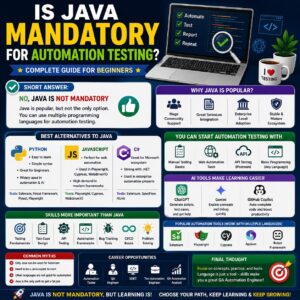
The simple answer to Is Java Mandatory for Automation Testing? is No, Java is not mandatory.
Java is one of the most widely used languages for automation testing, but it is not the only option. Modern testing frameworks support various programming languages, allowing testers to choose based on their background and career goals.
If you’re wondering Is Java Mandatory for Automation Testing?, the reality is that many successful automation testers use Python, JavaScript, C#, and other languages.
Why Java Is Popular in Automation Testing
Although the answer to Is Java Mandatory for Automation Testing? is no, Java remains popular because:
- Large community support
- Strong Selenium integration
- Extensive documentation
- High demand in enterprise companies
- Stable and mature ecosystem
These advantages explain why Java is frequently recommended when discussing Is Java Mandatory for Automation Testing?.
Best Alternatives to Java for Automation Testing
When researching Is Java Mandatory for Automation Testing?, it’s important to know your alternatives.
Python
Python is beginner-friendly and easy to learn.
Benefits:
- Simple syntax
- Faster script development
- Popular in automation and AI
Many newcomers asking Is Java Mandatory for Automation Testing? choose Python as their first language.
JavaScript
JavaScript is widely used with:
- Playwright
- Cypress
- WebdriverIO
It is a great choice for web automation and a strong alternative for those questioning Is Java Mandatory for Automation Testing?.
C#
C# is commonly used in Microsoft environments and enterprise projects.
Benefits include:
- Strong integration with .NET
- Enterprise-level automation frameworks
This makes C# another option when evaluating Is Java Mandatory for Automation Testing?.
Can You Learn Automation Testing Without Java?
Absolutely.
Many beginners start their journey by learning:
- Manual Testing
- API Testing
- Postman
- Selenium Basics
- Playwright
- Python Automation
These paths prove that Is Java Mandatory for Automation Testing? is a misconception for many aspiring QA engineers.
Role of AI Tools in Automation Testing
AI tools are changing how people approach Is Java Mandatory for Automation Testing?.
Popular tools include:
- ChatGPT
- Gemini
- GitHub Copilot
These tools help testers:
- Generate automation scripts
- Debug code
- Explain frameworks
- Create test cases
Because of AI assistance, learning automation testing has become easier for those wondering Is Java Mandatory for Automation Testing?.
Skills More Important Than Java
Instead of focusing only on Is Java Mandatory for Automation Testing?, beginners should build these skills:
- Software Testing Fundamentals
- Test Case Design
- API Testing
- Automation Framework Concepts
- Bug Tracking Tools
- CI/CD Basics
- Problem Solving
These skills often matter more than the programming language itself.
Career Opportunities in Automation Testing
After understanding Is Java Mandatory for Automation Testing?, you can pursue roles such as:
- Automation Tester
- QA Engineer
- SDET
- Test Automation Engineer
- QA Automation Analyst
Companies hire professionals based on overall automation skills, not just Java expertise.
Common Mistakes Beginners Make
When learning Is Java Mandatory for Automation Testing?, avoid these mistakes:
- Thinking Java is the only option
- Ignoring testing fundamentals
- Skipping API testing
- Avoiding practical projects
- Focusing only on theory
Avoiding these mistakes can accelerate your automation testing career.
Final Thoughts
So, Is Java Mandatory for Automation Testing? The answer is clearly No. While Java remains one of the most popular languages for Selenium and enterprise automation projects, many alternatives such as Python, JavaScript, and C# are equally effective.
Instead of worrying about Is Java Mandatory for Automation Testing?, focus on learning testing concepts, automation tools, API testing, and real-world projects. With AI tools like ChatGPT and Gemini helping developers and testers every day, entering the automation testing field has never been easier.